
Sailing Northern Brittany: The final leg
- Tom

- Jul 11, 2025
- 5 min read
Updated: Jul 15, 2025
For anyone who has not sailed in Brittany, you do not know what you are missing! The place has everything (apart from the all year round good weather).. The huge tidal ranges and challenging rock strewn coastlines scare some people. Yet, everything is so well marked and the charts so accurate that, in my opinion, it is a fairly straightforward place to sail.

After an Atlantic crossing, L'Aberwrach is a perfect arrival port because the entrance is relatively easy and, being in northern Brittany, you avoid the Chenal du Four and the complications sailing north from Brest.

It is almost the most western point in France and sunsets are lovely. We arrived late afternoon, were delayed by an over zealous customs team and yet we had time to enjoy a proper celebration and evening meal before taking a three hour coastal walk, enjoying coastal views and a late sunset.
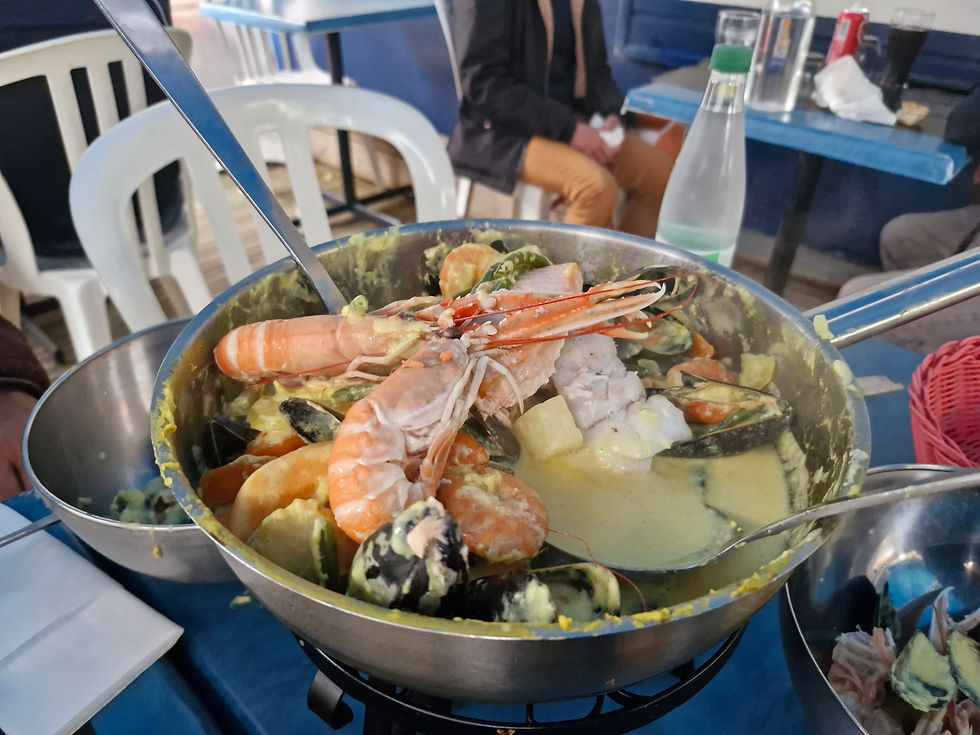
I have been coming here since 2017 and the establishments are definitely starting to move more 'up market'. Yet, A 'fisherman's pot' is still delicious and good value.
We only stayed in L'Aberwrach for one day. Just long enough to take care of laundry, do a bit of boat cleaning and relax. Amazingly, after the passage from the Azores, there was nothing to repair!

Our next destination was Roscoff, just 30nm along the coast. We had a nice wind, no rain and an easy sail towards Ile de Batz, the small island just to the north. Many newcomers to the area sail around this island but, at high tide, there is a route inside which allows you to practise your 'rock hopping' skills.

Roscoff became famous in the 17th century as the port from which goods were smuggled back and forth into England. There is a huge amount of history and all the houses are made of natural stone with slate rooves.

Like much of Brittany, it has an active fishing fleet. They operate out of the old (drying) harbour. (The marina is in a new 24/7 access port just around the corner)

Today, Roscoff is a popular tourist destination in the summer. There are several upmarket 'chocolatiers' and amazing patisseries. We also found a restaurant with FIFTEEN different 'recommended badges on the wall (Michelin guide, Petit Fute, Le Routard, Gault Milau, Lonely Planet, etc). Of course, we had to try their reasonably priced, three course menu. The dessert was a work of art with the rhubarb and strawberry 'fruit salad' topped with a biscuit supporting an array of delights.

Morlaix is another place worth visiting. The town is dominated by a viaduct (which you can get up to and walk across). Access is via a river that dries completely. So the approach is best done on a rising tide, in good time so you get the right side of the lock gate before the tide goes out!

The old town is not so big but has many original facades and some famous shops - like this patisserie:

We rented a car and drove along the coast for a day. It seemed like every village had it's own sailing school. It is no wonder the French are so good at the sport. Not only do they start young, but Brittany is the only place to be if you want to train to have any chance in offshore racing. There is a natural progression through the foiling yachts from Mini Transat, to Figaro class, to Class 40 and finally, the Imoca fleet (Vendee globe yachts). Even competing in the Mini Transat is too expensive for most without sponsorship and you have to get results at one level to have a chance of attracting money for the even more expensive next level.

We were drawn to a tourist attraction described as a 'cimetiere'. At first, I thought it must have had something to do with one of the world wars. But we were too far west, This graveyard was for old fishing boats!

The coast is indented with rivers and two of the nicest to explore are the ones to Treguier and Lezadrieux. For both, mooring can be quite tricky as the current flows diagonally across the pontoons. It is, therefore, advisable to arrive at slack water. The marinas may be several miles upriver, but the rivers pass through delightful countryside.

From Treguier, the main (easy) channel faces north west. Leaving to continue east gives the choice between a detour of several miles, or 'rock hopping' through the trickier 'Passes de la Gaine'. We got lucky because, just as we were approaching the narrow bit, the ferry came by and we could simply follow it through.

We were now in 'Channel Islands' territory, with strong currents and 10m tidal ranges. We had very light winds and, to make progress, you had to leave at the right time to catch the tide. Going east, this means leaving at low water and this limited our overnight options to ports with 24/7 access. There are two situated in the right places and we used both: Saint Quay Portrieux and Saint Cast.
It was another reminder that our RTW adventure was over. We quickly got into the habit of using marinas (rather than anchoring) and the prices were rather high compared to anything I had paid in the previous three years. (Thank goodness we were not sailing in the Mediterranean where prices are even higher!)
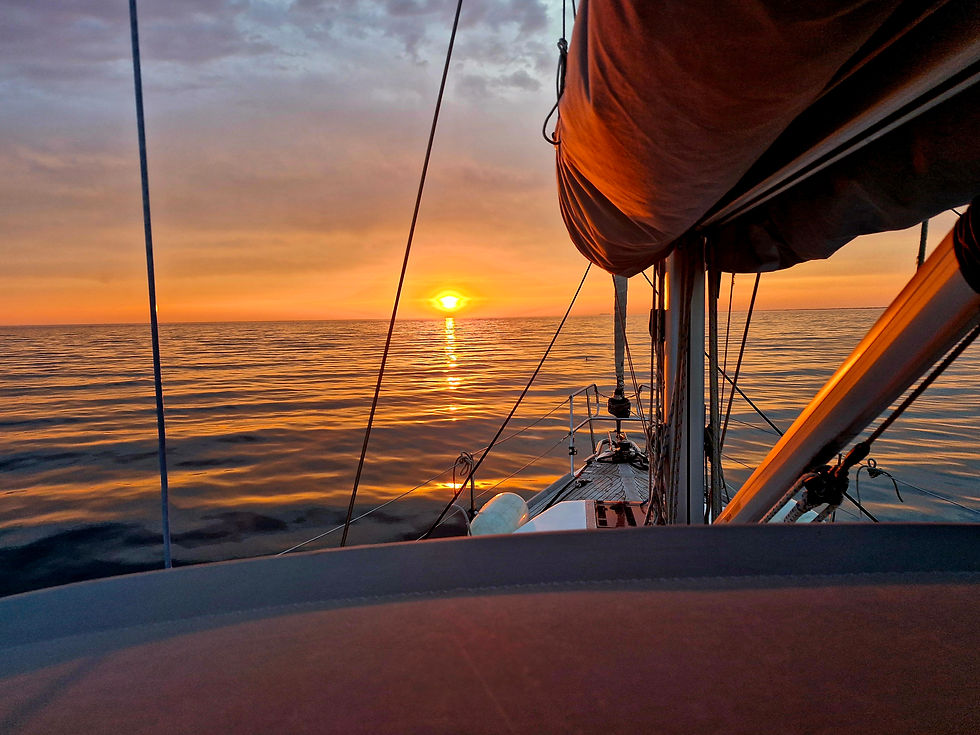
Our final day took us to Granville, where we had to arrive at high water. We left Saint Cast at first light and were treated to a beautiful sunrise. It was a relaxing, light wind sail. Perfect for a last day. We had the boat tied up and put to bed before 15.00, allowing us time to have a look around the town.
It is quite touristy with many restaurants and a quite nice beach. Low water reveals a 25m lido (sea water swimming pool which is 'refreshed' every high tide). We were there late June, which was still quite early in the season, so it was not so crowded.

This was Martin's last night before he returned to Switzerland. Given the difficulty in finding fresh seafood in such a land-locked country, we decided a seafood platter, at a restaurant with a sea view, would make for an appropriate 'last supper'. As we were in France, we chose to compliment it with an excellent Chablis.

And that is just about it folks. We left the boat to return to our respective homes the next day. The last leg was a complete contrast to most of the RTW trip. Short (30nm) daily hops, staying in marinas and eating in nice restaurants most evenings. Somehow, it seemed an appropriate way to wrap up four years as a live-aboard.
The boat will stay in Granville (good access to the Channel Islands and not too far from Belgium), at least until the end of July. There is some cosmetic work to be done to the interior as four years of constant use, coupled with a couple of leaks, have taken their toll on the headlining.
But the RTW trip is done and this is probably my last blog post. I expect to keep the website live for the next year but will likely not renew when my subscription runs out. Thanks for reading and following my adventures. I have enjoyed trying to write coherently. I hope you have enjoyed reading some of it.


Tom, congratulations on completing this amazing adventure and for writing such eloquent and intersting posts. I have thoroughly enjoyed following your journey. I hope that you are planning to write a book! Any time you are in the States in the Washington DC area please let me know. Terry Unter
Congratulations on your successful RTW adventure. We were blessed to share some of the adventures with you along the way. We appreciated reading of the ones we missed. Thank you for sharing.
Thanks for sharing your adventures, I've loved following your journey around the world. All the best for your future plans x
And so it ends…Congratulations, Tom, you actually did it. An amazing adventure I’ve enjoyed the occasional episodes though my grasp of the technical side is a bit tenuous. Regular holidays will seem tame in comparison. All the best, Gareth